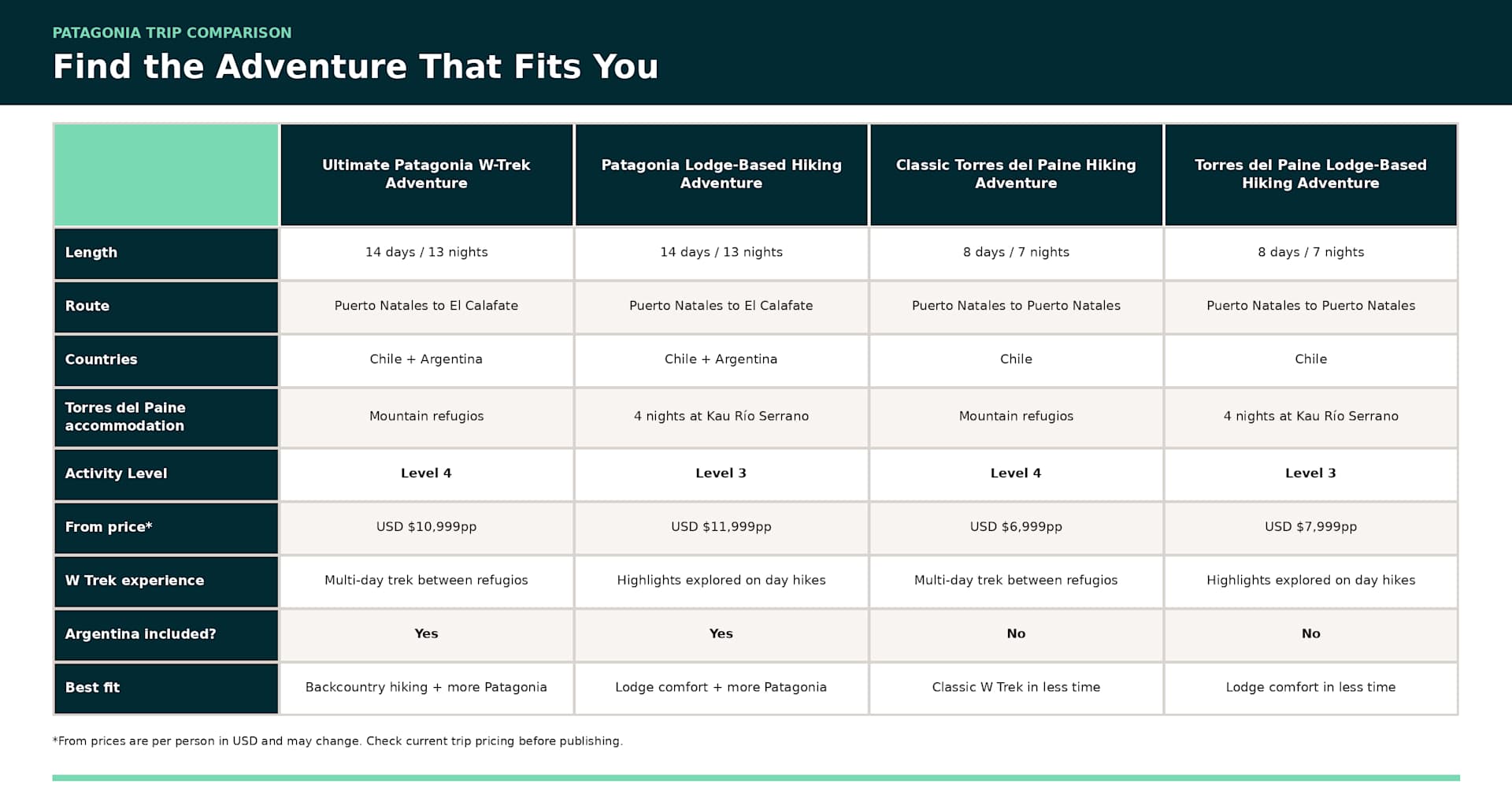
Compare Our Patagonia Trips at a Glance
So, you’ve decided you want to hike in Patagonia. Now comes the harder question: what kind of Patagonia experience do you want?
Choosing between our four trips that include Torres del Paine National Park isn’t only about selecting eight days or 14, or deciding whether you prefer a lodge to a mountain refugio. It’s really about how you want to travel through Patagonia.
You might want to shoulder your pack each morning and keep moving through Torres del Paine, sleeping beneath the mountains and watching the landscape change as you complete the W Trek. Or you might prefer to head deep into the park on day hikes, then return each evening to the same comfortable lodge.
And if you have two weeks, there’s another choice. Do you stop after Torres del Paine, or cross into Argentina and discover a different side of Patagonia altogether?
Check out our table above to help you to decide. But those facts only tell part of the story!
Backcountry or Lodge-Based? Two Ways to Hike Torres del Paine
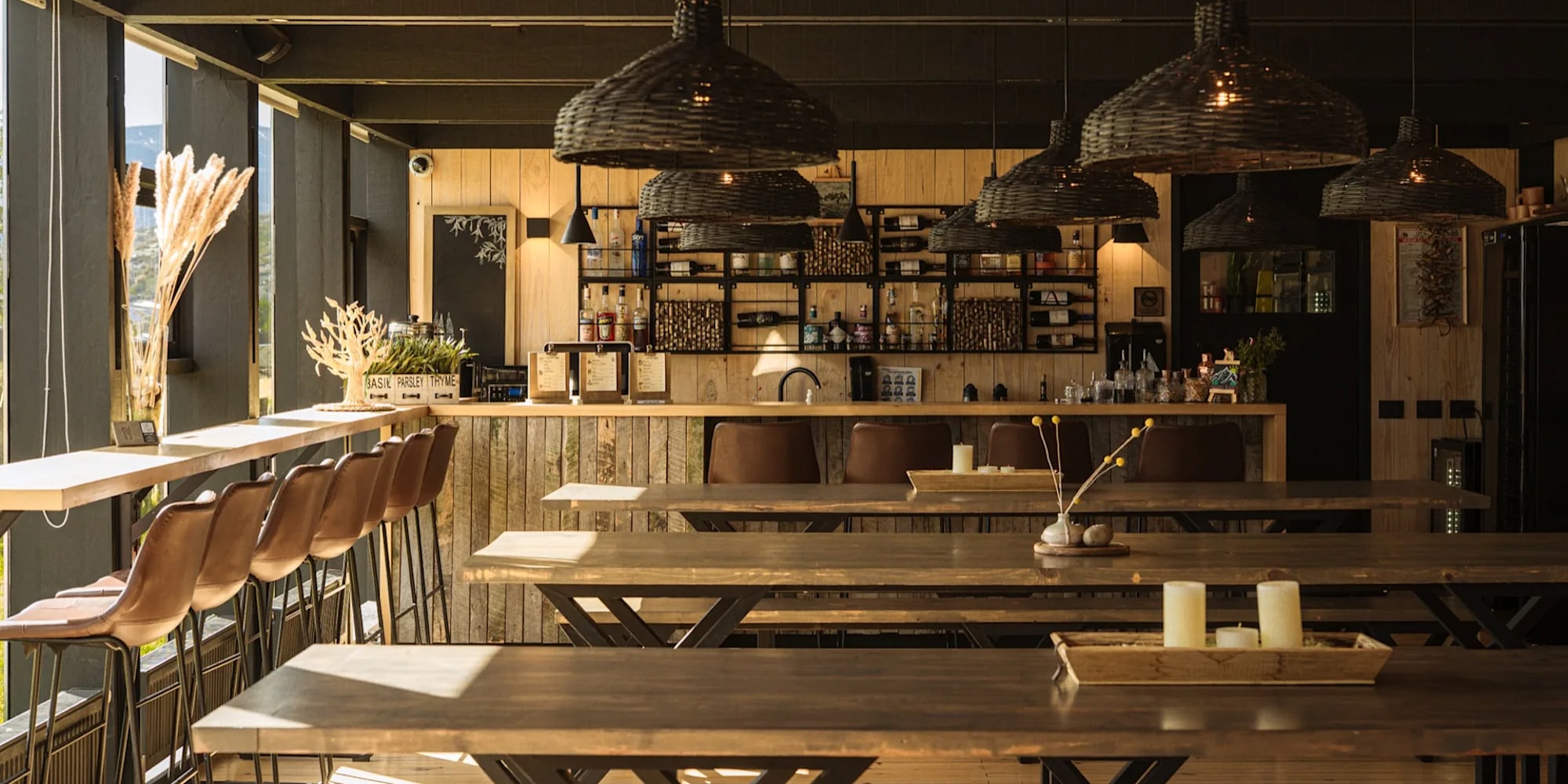
This might be a more useful way to think about the lodge-versus-refugio decision.
If you choose one of our lodge-based trips, you can head into Torres del Paine with your day pack each morning, then return to Kau Río Serrano at the end of the day.
On the Ultimate Patagonia W-Trek Adventure and Classic Torres del Paine Hiking Adventure, you don’t return to where you started.
You keep going.
And that changes the experience more than you might expect.
What’s so special about staying in the refugios?
On the W Trek, the refugios aren’t simply mountain accommodation. They’re part of the journey.
Your bed moves with your progress along the trail. Each evening marks another section of the W completed, and the following morning you step outside and continue from where your boots stopped the day before.
Refugio Cuernos: Sleeping Beneath the Mountains
Take Cuernos. Its setting beside Lake Nordenskjöld, beneath the mountains, gives you the feeling of being held right inside the landscape.
Imagine arriving after a day on foot. Your pack comes off. The boots can finally be loosened. Instead of Torres del Paine being somewhere you visited that day, it’s where you are spending the night.
The next morning, you simply pick up the trail again.
That’s the magic of the refugio trips. You’re not just hiking in Torres del Paine. You’re traveling through it.
At Refugio Grey, the W Trek Meets the Ice
At the western end of the W Trek, the glacier landscape takes over. Refugio Grey sits near Grey Glacier, an outlet of the Southern Patagonian Ice Field, and marks one end of the famous W trekking circuit.
That’s useful context when you’re comparing the trips.
The W Trek gradually gives you a sense of where everything fits. Peaks that began as distant landmarks become the mountains you’ve walked beneath. Valleys become passages rather than viewpoints. Refugio names become memories attached to particular days.
What makes Refugio Grey memorable isn’t that it puts you “more inside” Torres del Paine than the lodge-based experience. It’s that your overnight stop forms part of your progress along the W. In the morning, you pick up the trail and keep moving.
What’s the Lodge-Based Torres del Paine Experience Like?
Does that make the lodge-based trips less adventurous?
Not at all. They simply offer a different way to experience the park.
With Kau Río Serrano as your base, there’s no requirement to carry your overnight belongings along the W or adjust to a new refugio each evening. The challenge can stay where you want it: on the trail.
You can put your energy into hiking through Torres del Paine, then come back to something familiar at the end of the day.
There’s an underrated pleasure in that. The second night, you already know where everything is. Your belongings aren’t traveling with you. When the Patagonian weather has reminded you who’s boss, you know precisely where you’re going at the end of the hike.
For travelers who enjoy big walks but don’t particularly dream about mountain refugios, that isn’t compromising on Patagonia. It’s choosing the way you most want to experience it.
Choose the W Trek if completing a continuous journey through Torres del Paine is part of the dream.
Choose lodge-based if it’s the hiking and landscapes you’re primarily there for, and you’d rather reset somewhere comfortable each evening.
Chile or Chile and Argentina? What the 14-Day Patagonia Trips Add
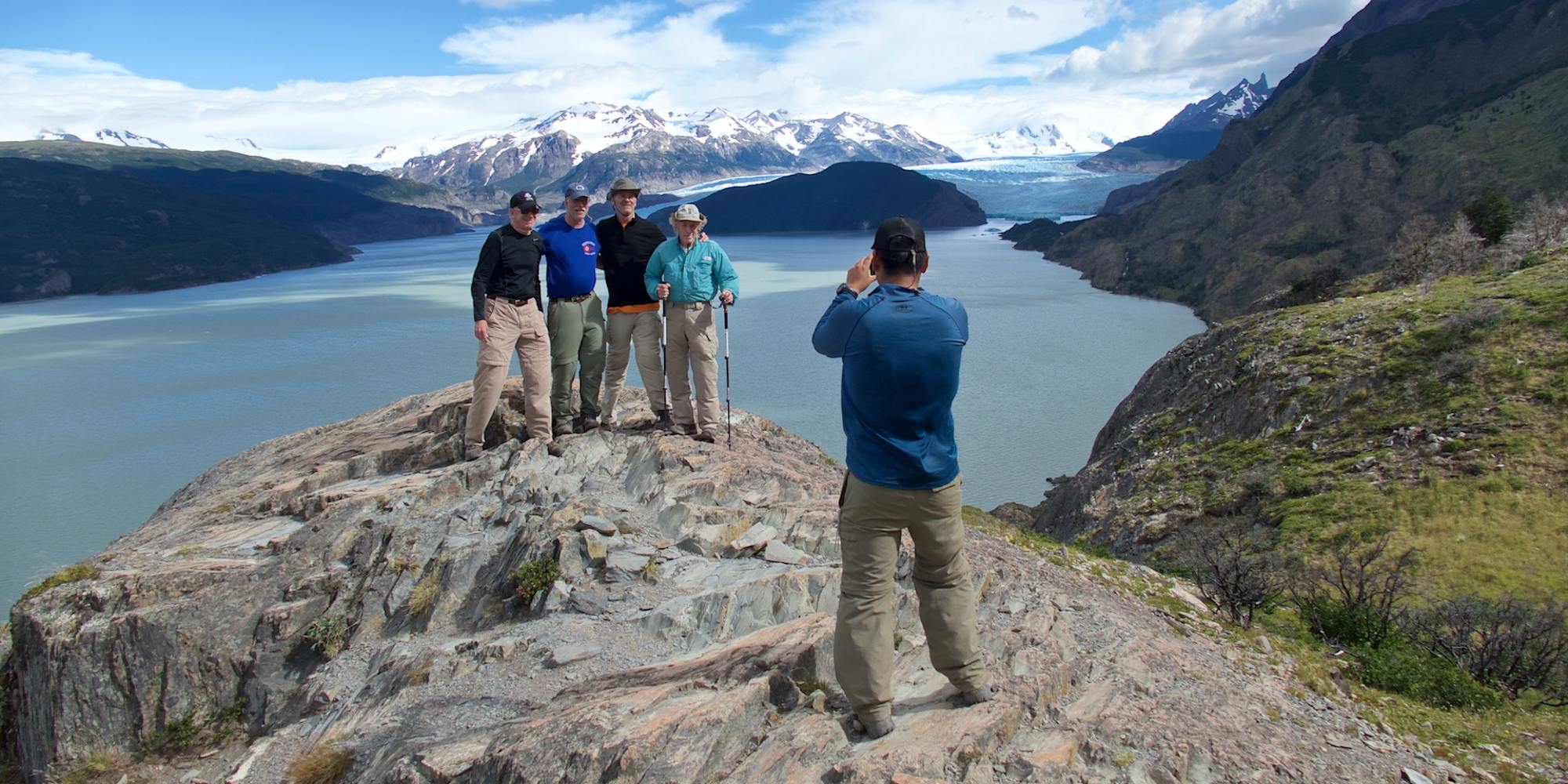
This is where the two 14-day adventures really start to distinguish themselves.
Adding Argentina isn’t simply a question of adding another country to your passport. The character of the journey changes.
How Does Argentine Patagonia Differ From Torres del Paine?
The Chilean part of the journey is centered on Torres del Paine, where granite peaks, glacial lakes, valleys, and ice all compete for your attention. On the backcountry trips, those landscapes connect as you move along the W Trek. On the lodge-based trip, you explore different sections on day hikes before returning to Kau Río Serrano.
Cross into Argentina and the experience changes. El Chaltén becomes your jumping-off point for individual hikes into the mountains, so each day takes you toward a different viewpoint or landscape rather than continuing along one multi-day trail.
Why El Chaltén Changes the Shape of the Hiking
El Chaltén is built around access to the mountains. Instead of following one long W-shaped journey, you’ll head out toward different corners of the landscape. And those walks are surprisingly different from one another.
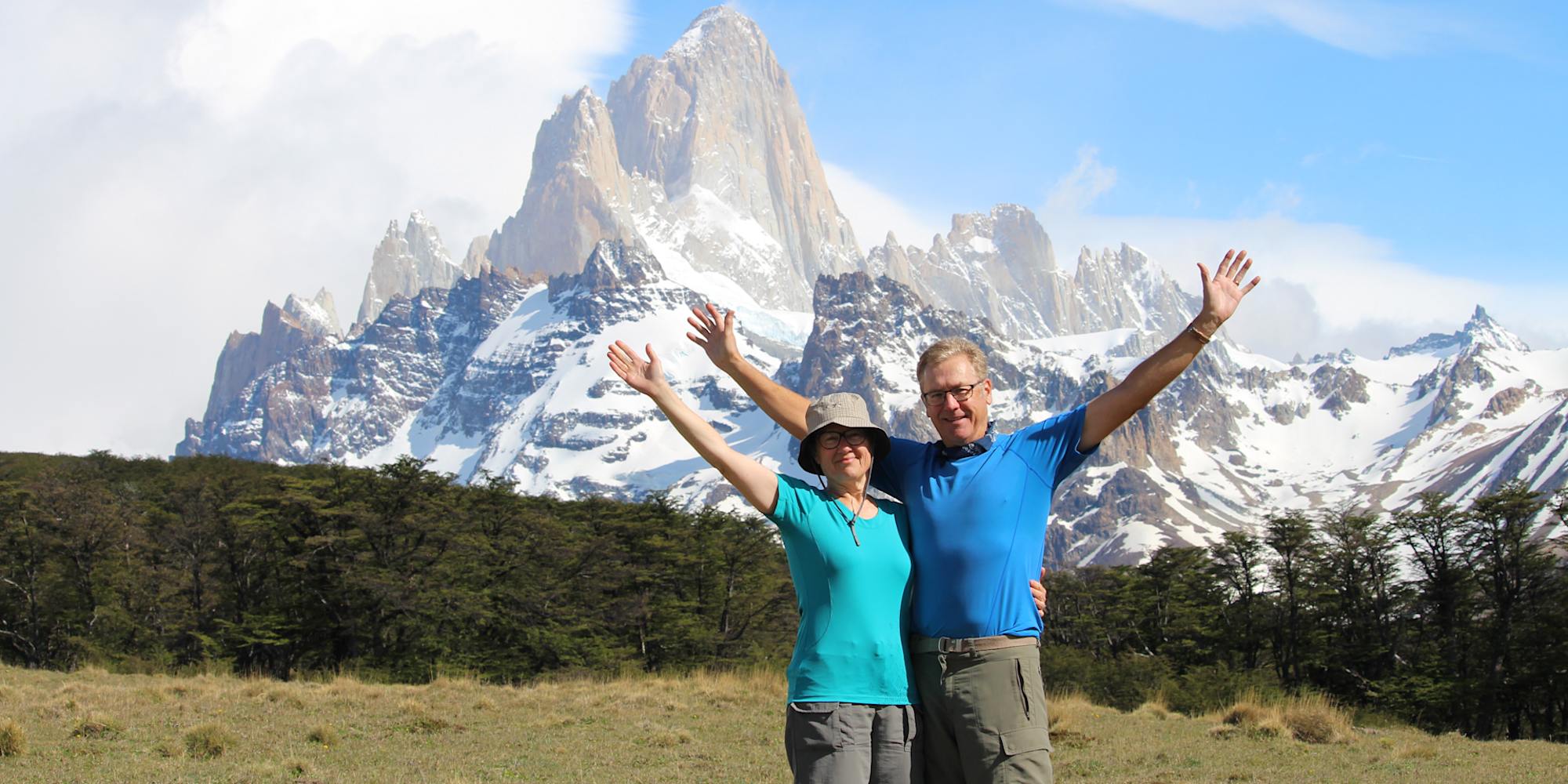
One day might take you toward the granite walls of Fitz Roy and Laguna de los Tres. Another draws your attention toward Cerro Torre. Loma del Pliegue Tumbado changes the perspective again, climbing above the valleys for a broader view across the El Chaltén mountain landscape.
That variety is one of the pleasures of the Argentine side. You’re getting to know the same mountain landscape from different directions, rather than simply moving on to the next famous sight.
Is It Worth Spending 14 Days in Patagonia?
That’s the real argument for 14 days. Not simply, “I have another week.” It’s, “I’ve come all this way. Do I want to experience Patagonia on both sides of the border?”
What are the Best Hikes Around El Chaltén?
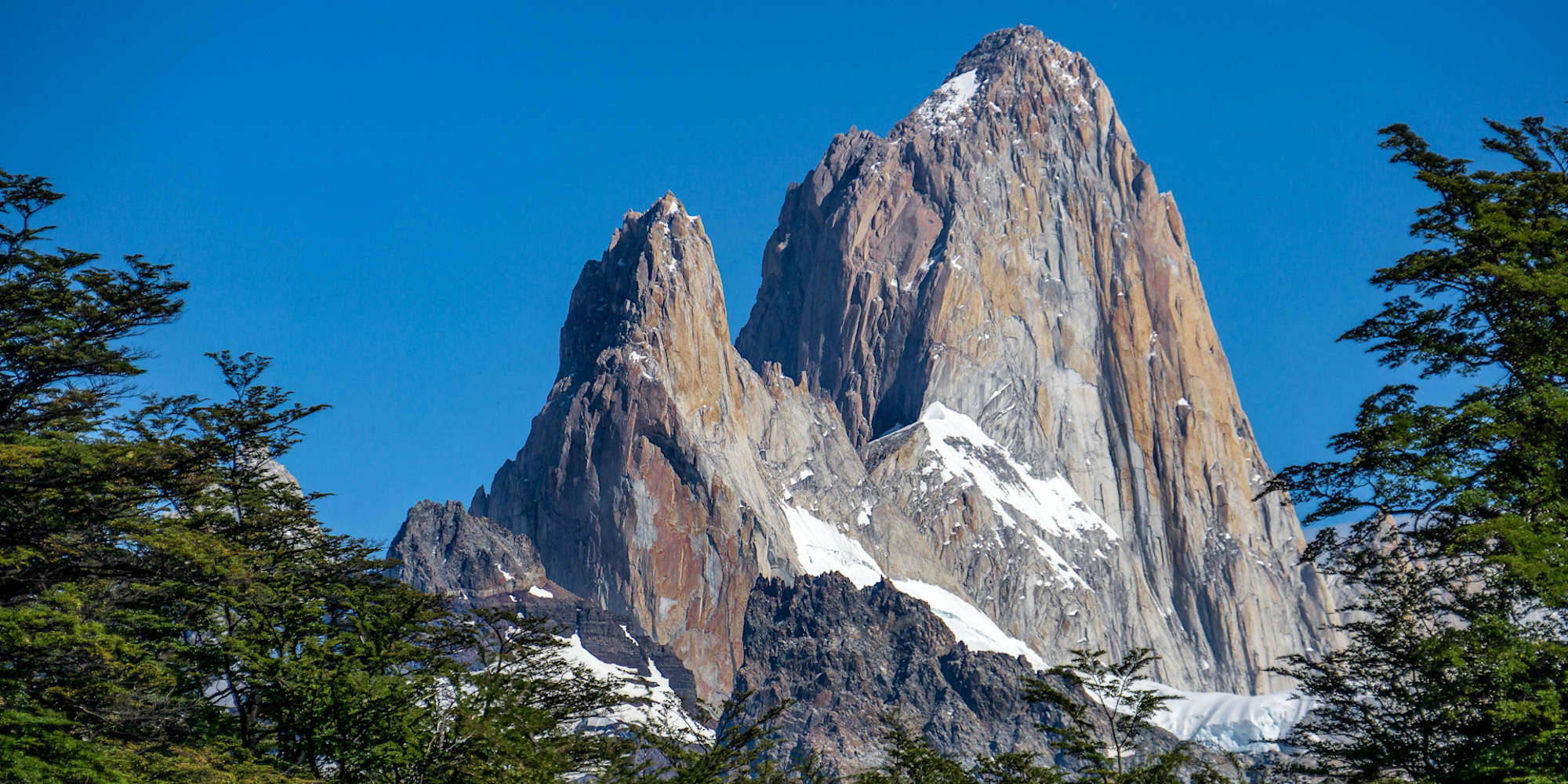
Laguna de los Tres: The Hike Toward Fitz Roy
If you’ve seen photographs of Argentine Patagonia, chances are you’ve already seen Fitz Roy. What photographs don’t communicate particularly well is the satisfaction involved in reaching its classic viewpoint.
The trail to Laguna de los Tres climbs through forest and the valley of Arroyo del Salto, offering glimpses across the Río de las Vueltas valley and toward the Fitz Roy massif. Eventually the route reaches its sting in the tail: a steep climb onto the old moraine holding Laguna de los Tres.
The lagoon sits at the foot of Fitz Roy. After hours of walking, you’re suddenly looking across glacial water toward granite walls that have been getting steadily closer all day.
This isn’t sightseeing with hiking added. The hiking is what gives the sight its meaning.
Cerro Torre: Seeing the Mountains From Another Direction
One reason the Argentine portion works so well is that Fitz Roy doesn’t swallow the entire itinerary.
Cerro Torre gives the mountain landscape another focal point. Rather than treating Patagonia as a succession of boxes to tick, the longer adventures let you spend several days getting to know this landscape from different directions.
One day the mountains are the destination. Another day, they’re the backdrop. And then there’s a hike that turns that whole perspective on its head.
Loma del Pliegue Tumbado: The Patagonia Hike You Might Not Know
Many of the best-known walks around El Chaltén draw you into the valleys toward the big granite peaks. Loma del Pliegue Tumbado does something different. It takes you above them.
The trail climbs through Patagonian forest before emerging onto increasingly open, exposed terrain. As you gain height, the view becomes less about one mountain and more about understanding how the whole landscape fits together. Fitz Roy and Cerro Torre appear across the same skyline, with Laguna Torre, the Fitz Roy River valley, and Lake Viedma spreading out below. That broad perspective is what sets this hike apart.
After several days of walking toward Patagonia's famous peaks, there’s something satisfying about finally getting above the valleys and looking back across them. Instead of another close encounter with one landmark, you get the bigger picture.
And on the way up, the trail has another surprise waiting among the rocks.
What Are Marine Fossils Doing Above El Chaltén?
That surprise is easy to miss if you don’t know what you’re looking for.
As the trail rises beyond the lenga forest and becomes rockier, marine fossils around 100 million years old can be found among the stones. Local information about the trail identifies remains including ammonites and belemnites in this higher section of the route.
Marine fossils, high in the mountains, seem wonderfully out of place.
But that's precisely what makes them so interesting. They're evidence of a landscape that looked completely different long before today's Andes dominated the horizon.
It gives you another reason to pay attention on the climb. Fitz Roy and Cerro Torre may be filling the skyline, but the rocks beneath your boots are telling a much older Patagonia story.
Why Perito Moreno Glacier Is a Highlight of the 14-Day Trips.
A Patagonia Experience Where You Don’t Have to Keep Walking
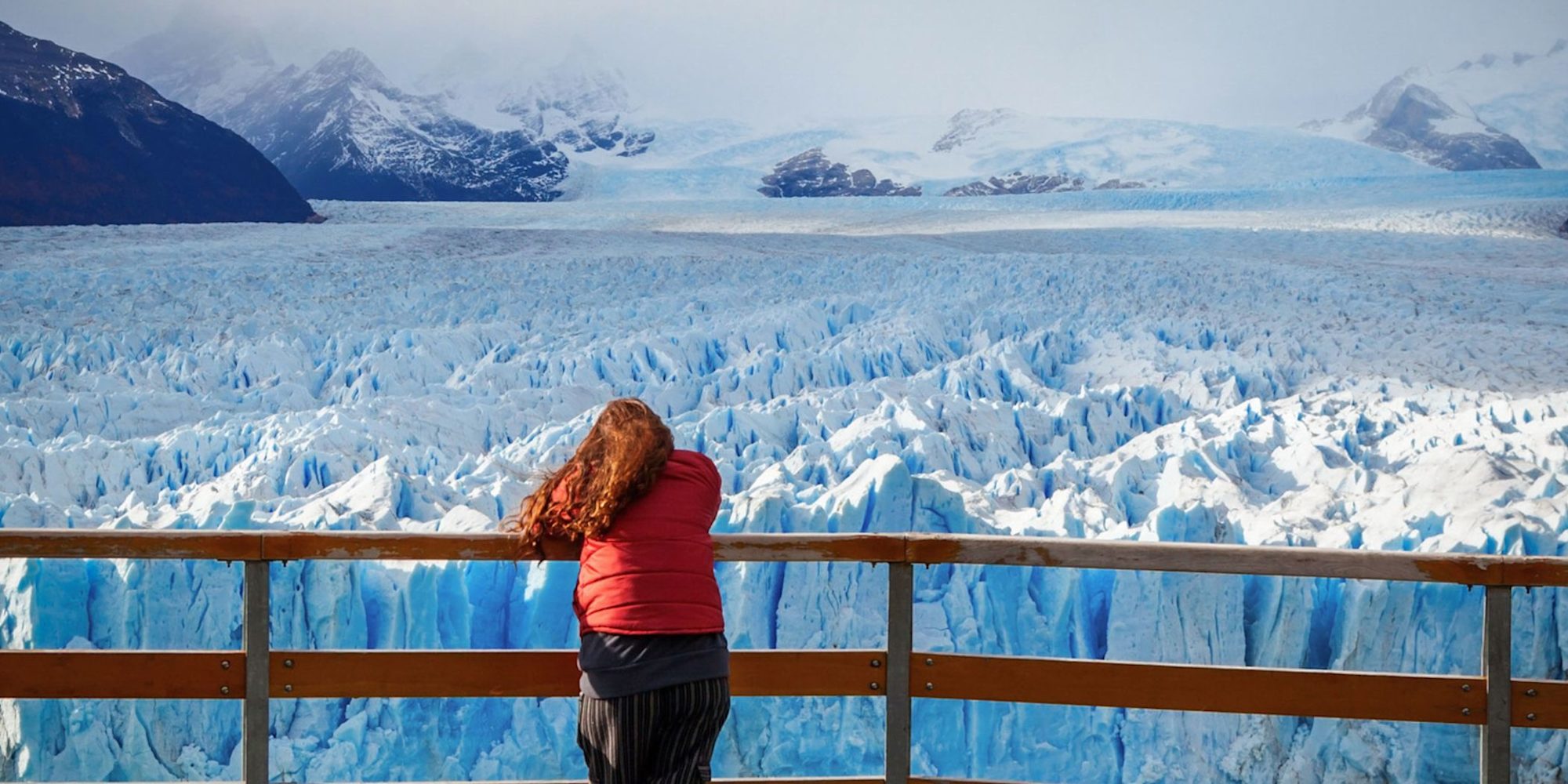
After days where the reward comes from putting one foot in front of another, Perito Moreno Glacier changes the pace.
This is somewhere to stop. Look. Listen.
Rather than seeing a glacier as a distant white tongue high in the mountains, the Perito Moreno experience brings you to viewpoints opposite its enormous ice front.
Around El Chaltén, you’ve been working for the viewpoints. Here, the glacier does the work.
What Makes Perito Moreno Different From the Glaciers You See on the Trail?
You can slow down and pay attention to the shapes, colors, scale, and movement of the ice. After measuring Patagonia in miles walked and trails climbed, there is something satisfying about simply standing before one of its great landscapes.
Which Active Adventures Patagonia Trip Should You Choose?
Four Trips, Four Different Patagonia Stories
Ultimate Patagonia W-Trek Adventure
For the hiker who wants the journey to matter as much as the destination.
This is the most immersive combination of the four.
You don’t simply enter Torres del Paine for a series of walks. For several days, you live along the W, moving between mountain refugios and watching the geography change around you.
There’s Refugio Cuernos beside Lake Nordenskjöld, then Refugio Grey near Grey Glacier. After Torres del Paine, the journey keeps unfolding as you cross into Argentina.
Suddenly you’re not completing one route anymore. You’re setting out toward individual mountain objectives from El Chaltén, getting acquainted with Fitz Roy and the surrounding landscape from different angles. Then comes Perito Moreno, where the pace changes again.
If what appeals to you about Patagonia is the feeling of making a genuine journey through it, rather than simply seeing its famous places, this is the strongest choice.
Patagonia Lodge-Based Hiking Adventure
For the hiker who wants the whole Patagonia story, but not necessarily the refugio story.
Importantly, you’re not giving up the contrast that makes the 14-day journey interesting.
You still experience the transition from Chile into Argentina. You still get the Argentine hiking experience around El Chaltén. You still reach toward Fitz Roy and encounter the huge ice landscape around Perito Moreno.
The difference is how you experience Torres del Paine. Rather than carrying your overnight gear deeper into the park and changing refugios along the W, Kau Río Serrano becomes your familiar base.
This version says: give me the trails, give me Patagonia, and give me somewhere comfortable to come home to.
Classic Torres del Paine Hiking Adventure
For the hiker who doesn’t just want to see the W Trek. They want to say they’ve walked it.
This experience is wonderfully focused. There’s no temptation to treat Torres del Paine as the first half of something bigger. Torres del Paine is the adventure.
Your accommodation becomes part of your progress. You move through the park rather than repeatedly returning to one point.
Refugio Cuernos isn’t merely somewhere on tomorrow’s itinerary. It’s where you arrive at the end of a day’s walking beside Lake Nordenskjöld. Refugio Grey isn’t simply a stop near a glacier. It places you near Grey Glacier at another end of the W.
If you’ve had ‘hike the W’ sitting on a travel wish list for years, this is arguably the purest expression of that goal among these four trips.
Torres del Paine Lodge-Based Hiking Adventure
For the hiker who wants Torres del Paine to have their complete attention.
There’s a nice simplicity to this one. One country. One extraordinary national park. One lodge base.
Rather than packing up and moving onward, you return to familiar surroundings each evening, reset, then head out again the following morning.
And because your trip isn’t continuing across the border into Argentina, Torres del Paine isn’t competing for attention with Fitz Roy or Perito Moreno.
For some travelers, that focus is precisely the appeal. You don’t need to see more Patagonia to feel you’ve had an adventure. You simply need to spend your time in the part of it you most wanted to see.
Which Patagonia Trip Would I Choose If…
“Completing the W Trek is on my bucket list.”
Choose the Classic Torres del Paine Hiking Adventure if you want to keep the trip focused on Chile. Choose the Ultimate Patagonia W-Trek Adventure if crossing into Argentina afterward makes you think, “Well, if we’re going all that way…”
“I love long hikes. I don’t love the idea of mountain refugios.”
Choose the Torres del Paine Lodge-Based Hiking Adventure for Chile only, or the Patagonia Lodge-Based Hiking Adventure for the longer Chile and Argentina journey.
“I’m never likely to come back to Patagonia.”
Look seriously at one of the 14-day trips. Not simply because they’re longer, but because Chile and Argentina give you different perspectives on the region.
“I want the most immersive trip.”
Choose the Ultimate Patagonia W-Trek Adventure. The combination of traveling through Torres del Paine on foot and then switching into the Argentine Patagonia experience makes this one distinctive.
“I want to hike hard during the day and properly relax afterward.”
Start with one of the lodge-based trips. The lodge isn’t there to replace the adventure. It simply changes where the challenge happens.
The Decision Is More Than 8 Days or 14
The practical comparison still matters. Eight days or 14. Level 3 or Level 4. Refugio or lodge. Chile or Chile and Argentina.
But those aren’t really the memories you’re choosing between.
You’re choosing whether you want to wake up inside Torres del Paine and continue a journey you started the day before. Whether you’d rather unpack once and walk into the mountains with a lighter load. Whether seeing Fitz Roy from the trail is worth crossing Patagonia for. Whether you’d get a kick out of finding 100-million-year-old marine fossils high above El Chaltén. Whether, after all that walking, you’re content to spend a few hours doing nothing more strenuous than watching a glacier.
Choose those experiences first. The right itinerary tends to become obvious afterward.
Explore our Patagonia Hiking trips that include the Torres del Paine National Park:
- 14-Day Ultimate Patagonia W Trek Adventure
- 14-Day Patagonia Lodge-Based Hiking Adventure
- 8-Day Classic Torres del Paine Hiking Adventure
- 8-Day Torres del Paine Lodge-Based Hiking Adventure
If you're wanting a different Patagonia experience to all of these, then check out our Northern Patagonia Adventure.
